In the rapidly evolving landscape of B2B marketing, professionals are currently standing at a crossroads. As generative AI reshapes the way we work, B2B marketers must decide exactly how deep down the AI rabbit hole they are willing to go.
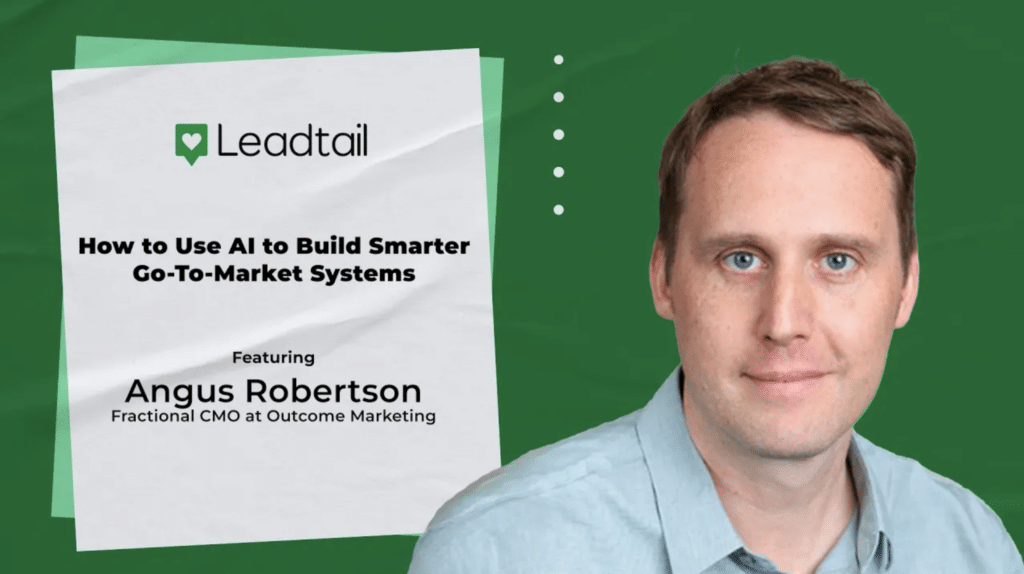
On an episode of the Tomorrow’s Best Practices Today podcast, host Clark Newby sat down with Angus Robertson to discuss the practical, pragmatic applications of AI in go-to-market (GTM) strategies. Angus is a fractional CMO at Outcome Marketing, an organization that partners with founders and CEOs on GTM clarity and AI-integrated growth strategies.
Drawing on his past experience as a fractional Chief Revenue Officer for Chief Outsiders and his time writing the tactical playbook Outcome Marketing, Angus is no stranger to rolling up his sleeves and executing hands-on growth strategies. Over the past few years, he has completely immersed himself in AI, transitioning from a traditional marketing executive to someone building complex AI workflows.
For B2B marketers looking to navigate this disruption, Angus’s insights provide a critical roadmap to navigate the new AI-powered GTM landscape.
The harsh reality for many SaaS products is that they are rapidly becoming irrelevant. As Angus points out, many software functions can now simply be replicated with some hardware, networking, and direct access to an LLM.
1. Unlocking Extreme Efficiency: From Months to Minutes
One of the most profound realizations for GTM leaders is the sheer speed at which high-quality work can now be executed. By embracing AI tools like Claude, VS Code, GitHub, and Cloudflare, Angus dramatically condensed traditional marketing timelines.
- Building a comprehensive, high-quality website that historically took two to three months was completed in just four to nine days.
- A complex competitive landscape diagnostic—which previously took a team of people several weeks to compile—can now be executed in just 10 minutes using platforms like Vercel and Supabase.
- This AI-driven diagnostic provides an in-depth view of how a brand’s presence compares to competitors across LLMs, highlighting market gaps and emerging opportunities.
For B2B marketers, this means they can no longer afford to spend months pummeling product marketing for content; they must leverage AI to accelerate value delivery.
2. The Power of “Connecting the Disconnected”
The true magic of AI in marketing is not just doing things faster or cheaper, but its ability to connect disparate systems that could never be connected before.
Angus successfully engineered a continuous, automated feedback loop for his GTM strategy:
- An AI tool conducts a competitive digital diagnostic.
- The insights from that diagnostic automatically inform and update a brand style guide, including positioning and messaging.
- The updated style guide then automatically builds or updates the company website based on established templates.
- The loop incorporates Voice of Customer (VoC) interview data, meaning that when customer resonance shifts or a competitor changes tactics, the style guide and website automatically update in real-time.
This interconnected approach ensures that a marketer’s go-to-market engine is perpetually optimized and aligned with actual market realities.
3. Embracing the “Long Tail” of AI Micro-Apps
Just as Amazon created a long tail for retail products and YouTube created a long tail for niche media broadcasting, AI is creating a massive long-tail opportunity for software.
Because AI has effectively erased the technical barrier to entry, anyone—from a plumber to a teacher to a B2B marketer—can now build their own custom application. Angus predicts an explosion of hyper-niche solutions: if the market currently sustains 20,000 SaaS companies, there is no reason it cannot support 200,000 or even 500,000 highly specialized AI apps.
This creates a lucrative opening for B2B marketers, small businesses, and solopreneurs to act as deep domain experts, building highly tailored AI solutions that serve very specific micro-market segments.
4. Stop Pouring “AI Sauce” on Broken Processes
Despite the incredible capabilities of AI, organizations must avoid the trap of automating subpar processes. Often, AI adoption is driven by external pressures—such as a CEO needing to tell their board about an AI strategy—rather than a genuine focus on customer outcomes.
- Automating a broken process simply causes an organization to tangle things up faster and hit the wall harder.
- AI is not a magic sauce that can be poured over a fundamentally flawed GTM strategy to fix it. If a brand lacks differentiation, AI will not figure it out for them.
- Relying purely on an LLM without human intervention will result in content that sounds exactly like the default, terrible marketing and sales pitches that already cover 80% of the internet.
Human experience and judgment are still absolutely critical. Agencies must use AI to provide stability and directional signals, while relying on human expertise to tune the output and ensure an authentic voice that truly resonates with buyers.
5. Resources to Accelerate Your AI Journey
For B2B marketers ready to dive into the mix and rewire their skillsets, continuous learning is essential. Angus recommends several resources to help professionals stay on the cutting edge:
- Lenny’s Podcast: Specifically, the interview with Jean DeWitt, the COO of Vercel, who provides brilliant insights into the business and strategy of AI in go-to-market motions.
- ArjanCodes (YouTube): A highly practical channel for those who want to get into the technical weeds of setting up an AI development environment and unlocking massive productivity gains.
- Outcome Marketing: Angus’s book acts as a highly prescriptive playbook for achieving alignment and delivering GTM outcomes in this new era. You can find it on Amazon or by visiting outcome.marketing.
The AI revolution is here, and it is moving fast. By diving in, embracing a culture of continuous learning, and pairing powerful AI workflows with strategic human judgment, B2B marketers can position themselves for unprecedented success.
Watch Angus’ entire podcast episode for even more of his insights.