In the world of B2B marketing, “chaos” is often the default setting. Whether it’s a sudden shift in leadership, a disconnect between sales and marketing, or the relentless pressure from the board to deliver pipeline, marketing leaders are constantly navigating turbulent waters.
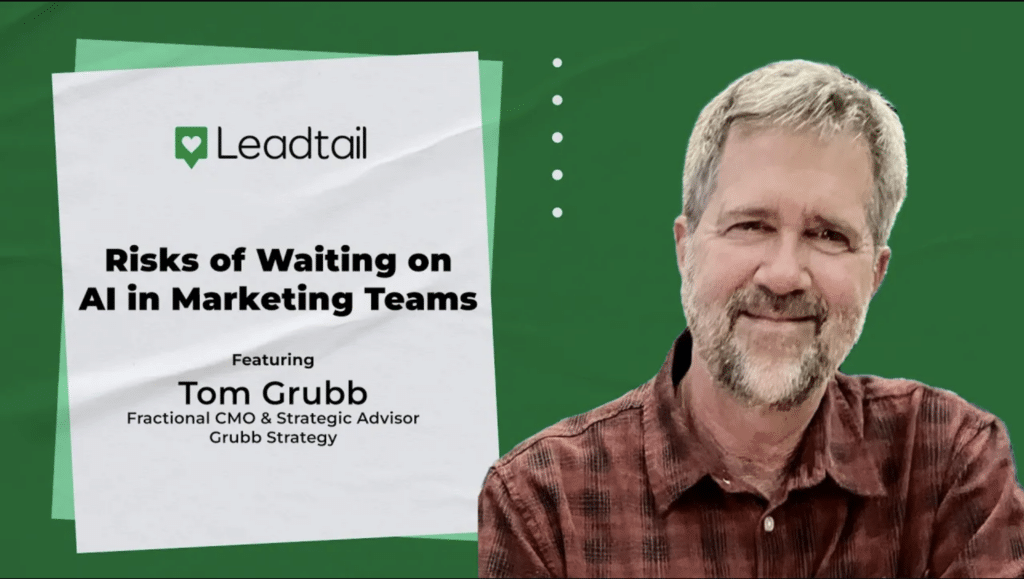
Tom Grubb, Founder and CMO Advisor of Grubb Strategy, joined Clark Newby on our Tomorrow’s Best Practices Today podcast to discuss how data and emerging AI technologies can help marketing teams find their footing.
As a consultant who specializes in sales and marketing enablement, Grubb’s mission is simple: use trusted information to bridge the gap between executive strategy and the reality of marketing operations.
For B2B marketers, his insights offer a glimpse into the future of “Agentic AI” and a blueprint for maintaining executive alignment.
The Pulse of Marketing Ops: A Radical Shift is Coming
While AI is currently the dominant topic of conversation, many practitioners are so busy keeping the trains running that they haven’t fully grasped the scale of the coming change.
When asking peers what marketing operations will look like in five years, the most honest answers were the most startling: no one really knows, but it will look nothing like today.
- Accelerated Rate of Change: The transition from early PCs to current tech took years; the AI revolution is happening in a relative blink of an eye.
- The Death of Footholds: What is considered “new” today is often outdated by tomorrow, making it nearly impossible to maintain a traditional technical foothold.
For marketers, this means that long-term strategic planning must be replaced by a culture of rapid experimentation and agility.
Beyond Rules-Based Marketing: The Rise of “Mary” and Agentic AI
One of the most significant shifts Grubb highlighted is the move from rules-based systems to reason-based agents. Traditionally, Marketing Operations has been defined by complex, often brittle rules meant to manage lead flows and data hygiene.
Grubb shared a groundbreaking example of a company that has built an AI agent named “Mary”.
Unlike traditional software, Mary can be deployed to handle low-level, tedious tasks—like list loads—using reasoning rather than fixed rules.
Perhaps more surprising than pre-built agents is the trend of marketers building their own custom agents. Marketers can now create a custom server layer to provide “context” from private data sets to an AI, making prompting significantly more effective.
“The technology and the tools are there, or almost there, to where anybody can go build these things on their own. That is a game changer.”
The Risk-Reward Triangle: Can You Afford Not to Try?
For marketers working in security-conscious environments, the primary hurdle for AI adoption is risk. However, Grubb suggests that companies must reframe their view of risk.
Instead of only asking “What happens if this goes wrong?”, marketing leaders must ask, “What happens if my competitor uses this to move faster than me?”.
While concerns about AI hallucinations and quality control are valid, these systems improve over time through human oversight and refinement. In a market moving this fast, sitting on the sidelines is often the riskiest move of all.
Solving the Age-Old Sales and Marketing Tangle
Even with advanced AI, the most common point of failure in B2B remains the disconnect between sales and marketing. Grubb notes that marketing leaders are often put in a position where they must “defend” their existence or “earn a voice at the table”—a footing that other executives, like the CFO or CRO, are rarely forced to take.
To align these teams, Grubb advocates for a few key strategies:
- Agreement on Measurement: Before a CMO even accepts a role, they must get a formal agreement on how they will be measured. If the clock starts running before the metrics are defined, the ending is predictable.
- Testing as a Core Competency: Marketing should be viewed as an organization that tests, measures, learns, and optimizes. Executives should judge a leader on their ability to improve the machine, not just on a single month’s pipeline number.
- Ending the “Source” War: Grubb cited a successful client who decided to stop debating “marketing-sourced” vs. “sales-sourced” pipeline. By recognizing that marketing’s “fingerprints are on the wrench” for most deals, they eliminated the dysfunction of internal gamesmanship.
Final Thoughts
The B2B landscape is becoming increasingly complex, with considered purchases involving dozens of people and year-long sales cycles.
In this environment, the “black and white” view of marketing as just a “lead gen team” is obsolete. By embracing the power of agentic AI and doubling down on data-driven alignment, marketers can move from being “defense” players to strategic leaders in the go-to-market machinery.
Want to gain even more insights from Grubb? Watch the complete podcast episode here.