For decades, B2B marketers have relied on a familiar playbook to generate leads: invest in paid ads, optimize for target keywords, and fight for a spot in Google’s traditional search results.
But what happens when the very nature of search fundamentally changes?
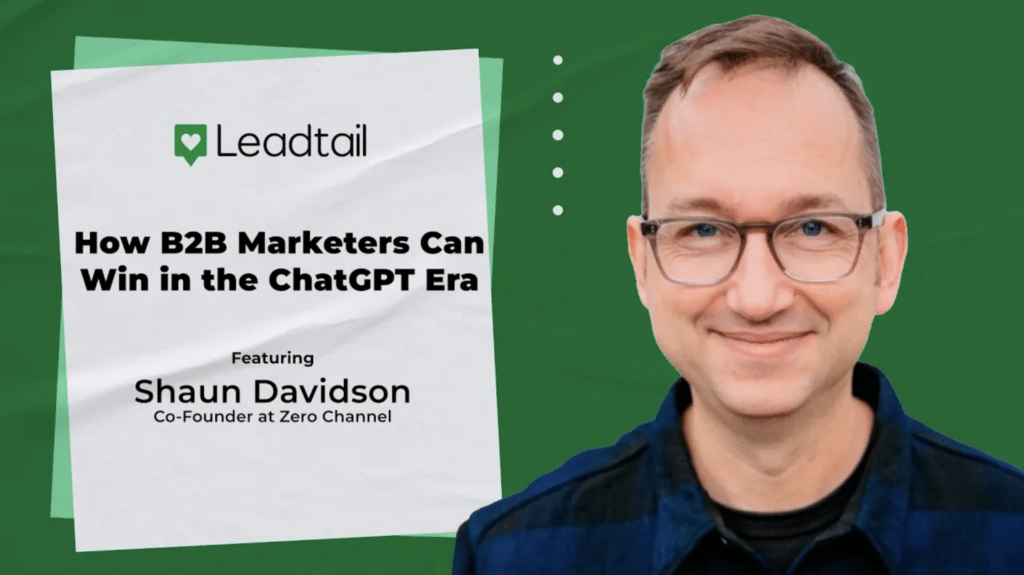
In an episode of Tomorrow’s Best Practices Today, Clark Newby sat down with Shaun Davidson, VP at Sembit Corp., to discuss a tectonic shift in the digital landscape. His journey into AI search optimization wasn’t born out of an academic exercise, but rather a harsh pragmatic reality.
The Catalyst: Failing at the Old Playbook
For many marketing leaders, the realization that the digital landscape is shifting comes after a painful investment. For Davidson, it was a $15,000 wake-up call.
Sembit dropped $15,000 on paid ads and received zero leads in return—an outcome Shaun described as a “big fat goose egg”. Attempts at running their own search engine optimization (SEO) were equally unsuccessful.
Around the same time, Shaun’s own online behavior was changing. Instead of opening Google, he found himself opening new tabs directly to ChatGPT. He realized that roughly 37% of people in the US are now starting their searches in chat interfaces like ChatGPT or Google’s AI mode.
When he checked to see if these models were recommending his consultancy, Sembit was nowhere to be found. This sparked an obsession with reverse-engineering how AI models recommend companies.
The AI “Junior Salesperson”
The transition from classic search to AI search changes how B2B buyers evaluate potential partners. Buyers are no longer just looking for a list of blue links; they are asking AI, “Who should I be talking to?”.
This shift completely disrupts traditional marketing attribution. Shaun realized the power of AI search when a high-value prospect reached out to Simbit directly. When asked how they found the firm, the prospect revealed they had a 30-minute conversation with ChatGPT before deciding to work with them.
In essence, the AI had acted as a junior salesperson, handling the consideration and vetting phases of the buyer’s journey entirely in private.
The Challenges of AI Engine Optimization (AEO)
While the opportunity is massive, optimizing for AI presents unique hurdles for B2B marketers:
- No Search Console: Unlike traditional SEO, there is no “Google Search Console” for platforms like OpenAI.
- Hidden Prompt Data: AI companies keep their prompt volume data completely private, meaning marketers have to make educated guesses or use reverse-engineered sample sets.
- Manual Attribution: Because AI conversations happen privately, there is no clear click-path; marketers often must rely on manual attribution, such as directly asking leads how they found them.
- Stochastic Results: AI models can be semi-stochastic, meaning an executive might ask an LLM about their brand 20 times and get varying results. Models are also silently updated and “checkpointed,” causing visibility to drift over time.
Mastering the “Citation Space”
If B2B marketers cannot see exactly what users are prompting, how can they optimize? The answer lies in the “citation space”—the areas of the web that AI models pull from to formulate their answers.
AEO is essentially SEO combined with citations and social proof. To get a company recommended by an LLM, marketers must strategically inject their brand into this space. Shaun highlights two primary ways to do this:
- Steering Earned Media: You cannot entirely control what third parties say, but you can guide them. For example, a doctor offering ADHD services could ask patients to specifically mention “ADHD” in their Yelp reviews. The platform pulls that keyword out, and language models associate the practice with that specific context.
- Real-Time Owned Media Tweaks: Brands can rapidly pivot the messaging on assets they control, such as a company website or a profile on industry directories like Clutch. By monitoring server logs, marketers can watch “chat user agents” hitting a profile, reading it, and preparing to regurgitate that information.
Attitude Dictates the Winners
B2B marketers are currently in the research phase of a brand-new marketing frontier. According to Shaun, nobody has completely figured out the final form this will take.
The difference between winning and losing comes down to mindset. The marketers that will thrive are those that view AI search as an exciting opportunity rather than a threat. By approaching AEO as a series of experiments, brands can go from being completely invisible to dominating the national conversation.
“Attitude is probably what’s going to dictate the winners and the losers here,” Shaun noted. The question is: will you lead the charge, or be left relying on a playbook from the past?
Watch Shaun’s full podcast episode to gain even more insights.