The rise of Artificial Intelligence is more than a new feature—it’s an industrial revolution. For B2B marketers, this era presents a critical challenge: how do you prevent simply automating broken, decades-old processes?
The answer lies in mastering change management and adopting the emerging framework of Growth Operations (Growth Ops).
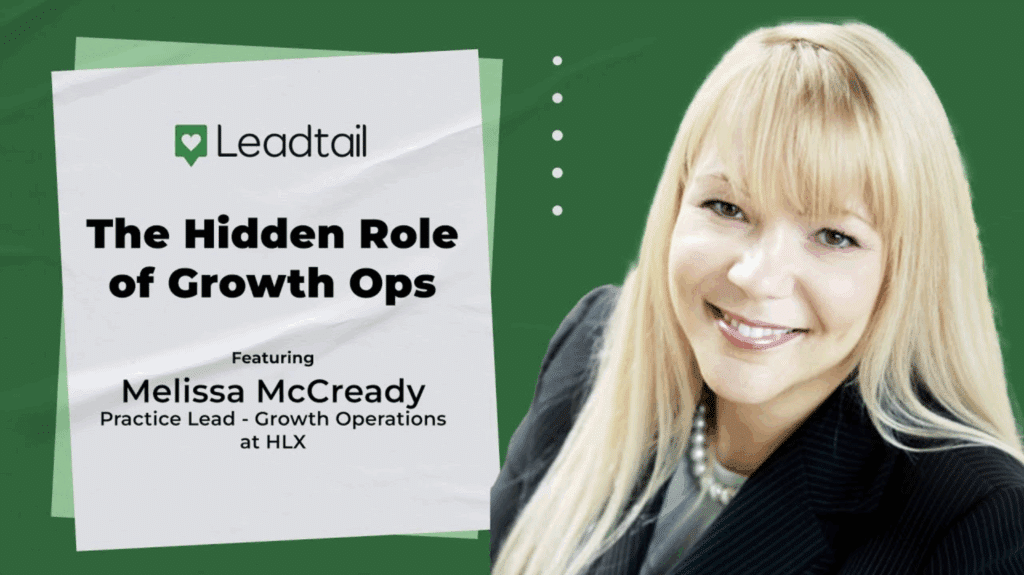
In an episode of the Tomorrow’s Best Practices Today podcast, host Clark Newby spoke with Melissa McCready, Practice Lead – Growth Operations at HLX, who shared her experience guiding high-growth companies through CRM implementation, data architecture, and the complex journey of AI adoption. Melissa’s insights offer a detailed playbook for addressing the foundational issues AI exposes.
The AI Challenge: It’s a Data Problem, Not a Technology Problem
Melissa finds that most companies are at the beginning stage of AI adoption, often getting “held up” trying to figure out what AI replaces versus what it does. The critical truth is that AI isn’t a replacement; it’s an enrichment and a co-pilot. However, the effectiveness of this co-pilot is entirely dependent on the quality of the data it learns from.
The Pain of the “Inherited Data”
Many companies, even those that have been around for over 20 years, do not have their data straight and rely on outdated processes. This creates a vicious cycle: using AI on a broken foundation is like “piling poop on poop”.
- Data First: The AI conversation must start with understanding your data set. This means distinguishing between structured data (consistent, pick-list values) and unstructured data (general text fields).
- The Neural System: Clean, well-governed data is the backbone and neural system of AI. Without it, no model can learn or be effectively trained.
The New Language of Instruction
Once the data is cleaned, the next hurdle is training the AI. This requires a different approach than traditional coding, emphasizing the most basic levels of instruction.
- The Peanut Butter and Jelly Analogy: Melissa uses the Peanut Butter and Jelly Sandwich Analogy to illustrate the complexity of training AI. You can’t just say, “Make a sandwich”. You have to define the most basic steps: Have a plan? A recipe? Money to go to the store? A ride to the store, etc.
- Mimicry Over Intelligence: Marketers must learn to feed AI, thinking of it as a learning machine that can be taught to mimic human voice or process, such as generating a sales sequence or leaving a voicemail. True general artificial intelligence is not yet in general use.
Key Takeaway: B2B marketers should formalize an “AI Readiness Audit” that prioritizes data cleanliness and process definition before implementation. Success is measured by the ability to “peel back the layers” to identify the true mission.
The Change Management Playbook: Crawl, Walk, Run
The soft side of AI adoption—human change management—is where many projects fail. Melissa’s approach is to minimize discomfort by offering a clear path forward: Crawl, Walk, Run.
Crawl: Eliminate the Drudgery
Start by finding the low-hanging fruit—the “busy work” or “PIAs” (pains in the…) that people don’t want to do anyway.
- Focus on Time-Saving: Identify tasks where AI can take something off a user’s plate that isn’t the core selling function.
- The Scheduling Automation Example: Automating the complex, multi-step process that follows a simple scheduling request: recognizing keywords in an email response, personalizing the follow-up, logging an activity in the CRM, adding the prospect to a list, and creating a follow-up task.
- Mindset Transformation: This approach ensures users feel better because AI is assisting them, fostering the transformational mindset necessary for broader adoption.
Walk: Connect the Dots to Outcomes
Once basic automation is in place, the team needs to connect the time savings to business goals.
- Executive Metrics: Leaders care about bottom line, margin, productivity, and focusing time on revenue-generating activities.
- Baselines and KPIs: You shouldn’t create a whole new set of AI-specific metrics at this point. Instead, baseline existing KPIs (like MQLs, conversion rates, and volume) and measure the impact AI has on improving them.
Operations Reborn: The Rise of Growth Ops
Melissa believes that the conversation around operations is shifting away from RevOps, which she finds “limiting” and “selfish” because it focuses narrowly on revenue.
The modern definition needed is Growth Operations (Growth Ops).
Growth Ops: The New COO 2.0
Growth Ops is defined as the complete orchestration of the business operationally. It is the overarching umbrella for all other operational teams:
- Growth Ops = COO 2.0: It takes on the strategic orchestration historically associated with a COO, but focuses on growth factors: high margin, high customer long term value, and low customer acquisition cost.
- The Orchestration: Growth Ops includes the traditional areas (Sales Ops, Marketing Ops) and emerging critical areas (Partner Ops, Customer Ops). Customer Ops is particularly fast-growing due to unpredictable markets, requiring intense focus on growing the existing business.
- The Shared Culture: The term Growth is preferred because it’s a shared, universal concern across the firm, partners, and customers, creating a common culture and shared experience.
Key Takeaway: Link the outcome not just to revenue (RevOps), but to the overall acceleration and increased margin across the business (Growth Ops).
The Future Ops Leader
For early-career professionals, Melissa advises:
- Generalist Breadth: Get a very wide breadth of experience in functional areas (AP, legal contracts, sales, marketing) to understand how the business functions as a whole—the “spine and the brain”.
- Soft Skills over Drudgery: Since AI will take over the muscle memory work (drudgery), career progression will depend on cross-departmental communication, executive-level conversation, and mastering soft skills like negotiation and conflict resolution.
Melissa is actively working to formalize this path with a RevOps Leadership course that focuses on these critical soft skills and the three career stages (early, mid, leadership). Her goal is to create a clear career path so that future leaders can build upon the foundations laid today.
Watch the entire Tomorrow’s Best Practices Today episode to get even more insights from Melissa.