In the world of B2B marketing, the challenge is often not about simply building a brand, but about intelligently evolving a long-established one for a new, digital-first era.
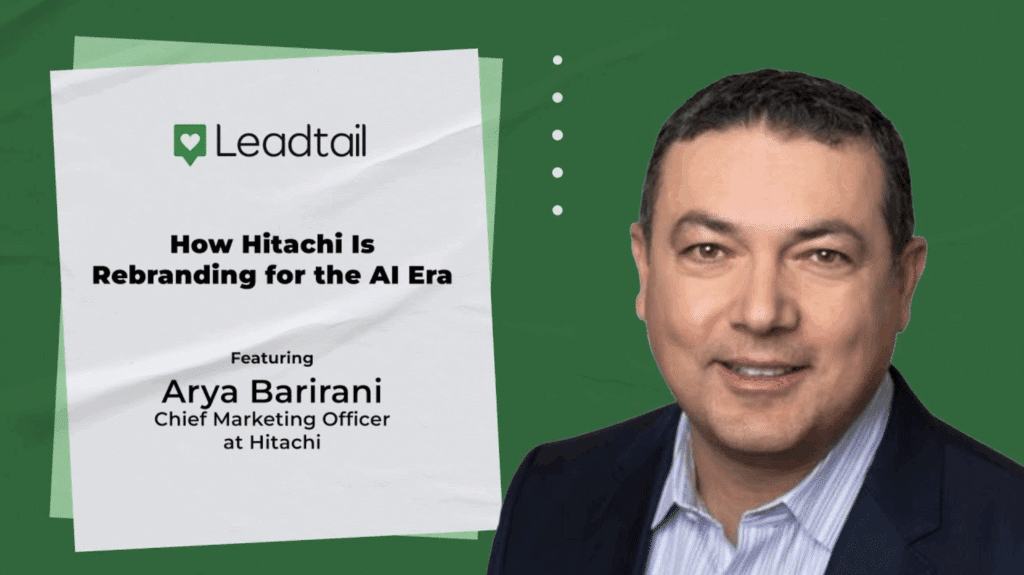
In an episode of the Tomorrow’s Best Practices Today podcast, we sat down with Arya Barirani, CMO of Hitachi Americas and Hitachi Digital, to discuss the monumental task of reframing a global, 110-year-old company for the age of AI transformation.
For B2B marketers, Aria’s insights—spanning brand strategy, lean organizational design, and high-value event execution—offer lessons on how to effectively guide your company through similar marketing transformations.
The Tyranny of the Existing Perception
For a company like Hitachi, which has pivoted from heavy equipment and consumer electronics (like TVs and laptops) to digital services, energy, and mobility solutions, the core brand challenge is unique.
As Arya explains, most people recognize the famous Hitachi logo and name, but often associate it with their legacy products—the “wrong thing” for their modern offerings.
“Everyone knows you, but they often know you for the wrong thing,” Arya notes. The task is not to introduce a new brand, but to use a “productive eraser” to shift the existing perception and “reframe the brand for the modern stuff”.
Key Takeaway: When repositioning a brand with a shifting business model, your first step isn’t just about crafting a new narrative; it’s about conducting an audit of the existing perception.
Where can the brand’s positive legacy attributes—like Hitachi’s widely acknowledged reputation for “reliability, safety” and being a “high quality product”—be leveraged, and where must they be actively overwritten for the new market?.
A Two-Part Marketing Formula: Above the Line and Account Engagement
Aria breaks down Hitachi’s marketing strategy into two primary, equally crucial components:
- Above the Line Brand Building: This focuses on “raw awareness for the cool stuff that we’re known for”. The big challenge here is cutting through the content “inundated” environment. Aria stresses a media strategy focused on relevant impressions, not just paid ones, and adapting content modalities to shrinking attention spans.
- Content Evolution: The shift is from long-form content (like 10-page white papers) to engaging formats, such as vertically formatted videos for platforms like TikTok or YouTube Shorts.
- Hyper-Targeted Social: Social media, especially LinkedIn, is considered a “very, very efficient channel” due to its hyper-targeting capabilities.
- Communications as Broadcast: Traditional media has given way to new media, with companies now acting as their own publishers via blogs and social posts. This mirrors the rise of “we’re all publishers now”.
- Account Engagement: This is the sales support function, ensuring the sales team doesn’t have to spend the “first 15 minutes… explaining how Hitachi has evolved”. For Hitachi’s high-touch, highly considered, committee-based sales model (selling long-term infrastructure like transformers is not an e-commerce transaction), marketing must adjust to a high-engagement model.
- ABM and Field Marketing: The core engine here is a highly focused Account-Based Marketing (ABM) approach. ABM personnel conduct account intelligence on a cohort of key targets (e.g., 20-30 accounts), defining profiles and feeding that data to the Field Marketing team.
- Boots on the Ground: Field Marketing is focused on getting sales personnel face-to-face with clients, driving towards the “ultimate thing” for a high-touch sale: breaking bread with the client executives.
Small and Nimble: Org Design for Speed
Despite representing a large organization, Aria notes that the central marketing team is “actually really small and nimble,” preferring a capabilities-driven organizational design over a massive headcount.
He looks for key “muscles” in the organization:
- Creative and Brand (with a bias toward awareness)
- Field Marketing and ABM
- Content Team
- Communications (PR, social media, internal comms)
- Operations (tracking KPIs and minding metrics)
Creative execution is often outsourced using a three-tier model: an expensive, high-level freelancer for main-stage content, a mid-tier person for PowerPoints, and a lower-cost geography for quick, high-volume needs.
The Face-to-Face Event Reframed as a Relationship Builder
In a world where 95% of education happens before a buyer is in-market, the traditional trade show is dead. Aria emphasizes that the purpose of face-to-face events is not a transaction, but relationship building.
Hitachi’s strategy for executive events is in high-value, non-sales engagement:
- Efficiency and Respect: Events are kept to a maximum of one day to respect executives’ time, allowing them to fly in for dinner and leave on the next flight.
- Zero Selling: There is “zero Hitachi content,” and not a single sales pitch presentation.
- High-Value External Content: Content is framed from the macro (geopolitical/economic worldview) down to the technological context. They bring in marquee external speakers, such as historians (Neil Ferguson) or business thought leaders (Good to Great author Jim Collins), to give attendees a “one-day MBA” experience.
- Customer Validation: They incorporate customers who discuss their challenges, allowing the audience to hear about value from an external source, which is the ultimate form of validation.
- Networking Focus: Long breaks and 90-minute lunches are intentionally scheduled to maximize networking time.
By committing to a model that seeks to “enrich these clients, not sell to them,” Hitachi has created a recurring event that clients genuinely want to attend, building a foundation of authentic trust.
For B2B marketers, this is a blueprint for high-level sales motions: shift event strategy from lead-generation to relationship-generation. Curate and execute high-value, bespoke experiences that earn the trust and attention of senior executives, creating a “warmed up audience” so that sales can focus purely on their work.
Watch the full podcast episode to learn even more about Ari’s approach.