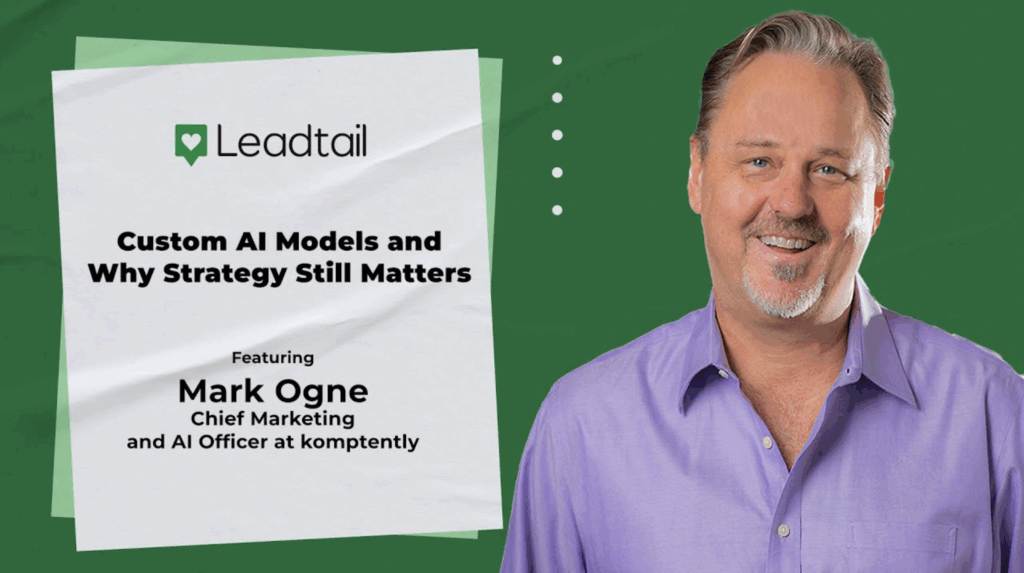
In a recent podcast episode of “Tomorrow’s Best Practices, Today” we had the pleasure of speaking with Mark Ogne, a true trailblazer in the B2B marketing and technology space.
As the Chief Marketing Officer and AI Officer at Kompetently, Mark offers a unique perspective on the intersection of AI, marketing strategy, and organizational growth. His career, which has spanned sales, e-commerce, and now AI, is a testament to his “tireless” desire to learn and build a diverse “tool belt” of skills.
For B2B marketers, Mark’s insights are a wake-up call. The era of focusing on mere efficiency is over.
The future belongs to those who master effectiveness, which, according to Mark, is fundamentally about understanding the “why” behind our work.
The Shift from How to Why
For years, B2B marketers have focused on the “how”—the technology, the processes, and the execution of campaigns. We’ve built careers around mastering specific tools and tactics.
However, Mark argues that AI is poised to commoditize the “how”.
He envisions a future where an “AI operating system” can be instructed by a marketer to build an entire campaign in a matter of minutes. You could ask it to draft a white paper, spin out email cadences, and generate social posts, all in response to a simple command.
This dramatic shift means that B2B marketers need to re-focus their efforts.
Instead of building more “crap faster” through efficiency, we must embrace the power of effectiveness.
Effectiveness is rooted in the “why”—the human element, the strategy, the objectives, and the deep understanding of a product and its market. It’s the difference between a person who has only built a hammer and sees the whole world as a nail, and someone with a versatile tool belt who can adapt to changing landscapes.
Mark likens the adoption of AI to the advent of the personal computer. Just as the PC fundamentally changed how we work, AI is not just another tool; it will require us to rewire our brains.
He sees AI as an Iron Man suit—a powerful tool that makes us better, faster, and more effective, but one that still requires a human at the helm.
The Magic of Custom AI: A Mile Deep, Not a Hundred Miles Wide
A key challenge with popular consumer-facing AI tools is that they are “a hundred miles wide and one mile deep”. They can provide information on a vast range of topics but lack the nuance required for a specific B2B context. Mark’s work at Kompetently, addresses this by building Custom Language Models (CLMs) that are “a mile wide, but… 100 miles deep”.
This approach eliminates the need for complex “prompt engineering” and allows users to simply converse with the tool.
The CLM is custom-trained on an organization’s entire universe of data, including websites, personas, capabilities, and marketing messages.
This process of reverse-engineering a company’s go-to-market strategy uncovers “nuggets” of valuable information that may be scattered across their website, recomposing them into a powerful, coherent narrative. The result is a system that can perform multi-dimensional analysis that a human mind cannot.
As Mark shared, he can instruct the AI to map product capabilities to personas and generate a one-sentence value statement for each intersection in just 35 seconds. This task would take a marketer at least a week to complete. The sheer speed and effectiveness of this process can be mind-blowing for clients, often requiring them to reset their entire way of thinking.
Mark’s focus is on creating solutions that are so knowledgeable they relieve the pressure on the user to conform to the tool. This is a significant shift from the current subscription model where you get a tool that might provide a “20 or 30% better idea, not a 90% better idea”.
The Future of Work: A Focus on Soft Skills and Agility
The implications of this shift extend beyond technology and strategy to the very fabric of an organization. As AI automates more of the “how,” a person’s career path will be less about mastering tools and more about mental and emotional agility, communication, and collaboration.
Mark pointed to a Pew Research Project that revealed a significant divide in people’s receptiveness to AI based on gender and race.
This suggests that before an organization can even begin to adopt AI, it must address the underlying soft skills and cultural resistance to change.
These “soft skills” are teachable, and C-level leadership plays a crucial role in fostering a culture where people are rewarded for trying, learning, and even failing.
For B2B marketers, the path forward is clear:
- Assess Your Organization’s Capacity: Before diving into AI tools, understand your team’s functional capability to absorb this change.
- Define the “Why”: Have a well-conceived organizational strategy and identify specific business objectives that you want to solve with AI.
- Start with Use Cases: Begin with small, focused use cases to test and learn before attempting to implement AI across the entire organization. Mark advises a “crawl, walk, run” approach to adoption.
Ultimately, the future of B2B is not about who has the best tools, but who can master the art of the “why.”
By embracing this mindset, we can leverage AI to create more effective, impactful marketing strategies that drive real, meaningful results.
You can get even more insights from Mark by watching the full podcast episode here.
Ready to get started with B2B social media? Let’s talk!