In the fast-paced, data-saturated world of B2B marketing, it’s easy to become consumed by spreadsheets, attribution software, and the ceaseless pursuit of signals. The result? We often strip the humanity out of marketing.
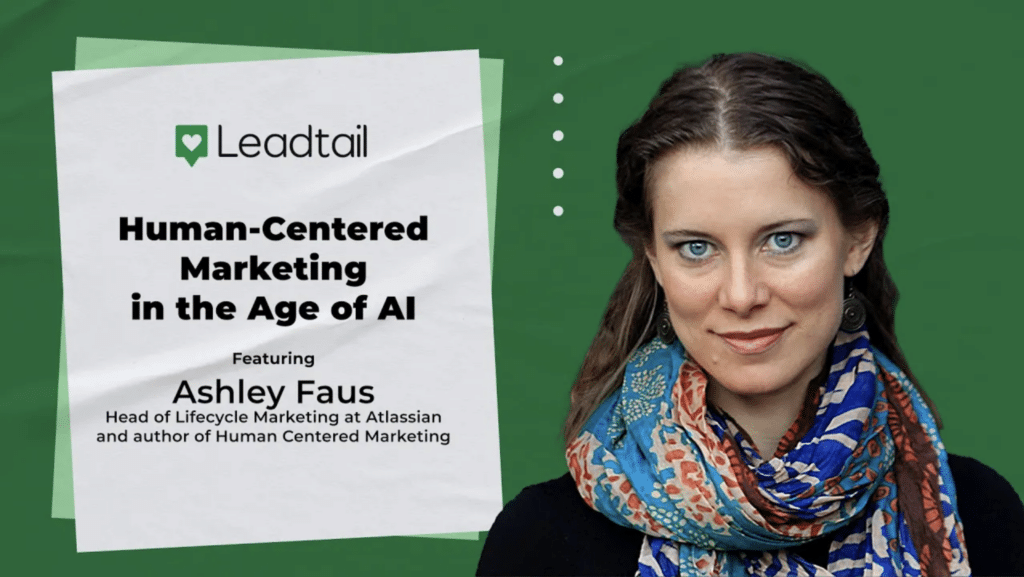
According to Ashley Faus, Head of Life Cycle Marketing at Atlassian and author of Human Centered Marketing: How to Connect with Audiences in the Age of AI, the most effective way for B2B marketers to succeed amidst the chaos of AI and new technology is to return to a fundamental truth: “We need to get back to the foundations of humans showing how they’re offering solves problems for humans.”
In an episode of the Tomorrow’s Best Practices Today podcast, Ashley shared her framework for placing the human element at the core of all strategy, ensuring B2B marketers can build not just pipelines, but genuine trust.
The Core Philosophy: From Broadway to the Boardroom
Ashley’s philosophy is rooted in the belief that marketing is fundamentally about people. Her approach shifts the focus from simply selling to serving the audience.
- Hearts Before Wallets: If marketers serve the audience, match problems with solutions, and get back to the humans behind the screen, the revenue, renewal, and expansion will follow. To win the wallets, we have to first win the hearts and minds.
- The Power of Trust: You cannot show actual business impact or make money if you are only focused on the spreadsheet. Winning requires building trust and serving the needs of the audience.
The Full-Self Principle
Effective human-centered marketing starts with the marketers themselves. Drawing from her background in musical theater, Ashley emphasizes that to truly be great in marketing, you have to fall in love with the audience.
- Integration, Not Separation: Marketers should strive for work-life integration, bringing all facets of their personality and passion—whether it’s fitness, baking, or theater—into their professional lives.
- Shared Language: Uncovering shared personal passions with customers (e.g., both nerding out about marketing and bodybuilding) builds a much stronger connection than conversations stuck in spreadsheets. This personal connection lights up both the marketer and the customer.
Key Takeaway: Foster a culture that allows marketers to bring their full selves to their work. This authenticity is the key to building the trust required for human-centered relationships.
Beyond the Funnel: Mapping the Customer Journey
Ashley’s framework challenges the static, linear funnel model, which often strips the actual humanity out of the process.
She proposes a model that centers on three intersecting components for success as a marketer: Thought Leadership, Content Strategy/Journey Mapping, and Social Media.
- Thought Leadership: This focuses on having genuine opinions and sharing smart thoughts that are interesting to the audience. In the age of AI, this is the human contribution that AI is not going to prompt itself to create.
- Content Strategy / Journey Mapping: This involves moving past the linear funnel to map out “a playground” or a looping decision journey for the customer. This mindset shift changes how campaigns, touchpoints, and media mixes are created.
- Social Media: This is the critical conversation with prospects and customers, where the brand is exposed, and relationships are built.
Key Takeaway: When thinking about content, shift the strategy from output volume (what AI is good at) to human insight (what humans are good at). The goal is to build an ecosystem of thought, content, and conversation that reflects the customer’s actual non-linear experience.
AI as the Ultimate Thought Partner
In the age of AI, the human role shifts from execution to strategic augmentation and creative problem-solving.
- The Medici Effect: Ashley references the concept of The Medici Effect, which involves combining specialists from diverse, seemingly unrelated fields to solve creative problems. For instance, bringing together an entomologist and an architect to design a temperature-regulated building, drawing inspiration from ant hills.
- Augmentation, Not Replacement: Marketers can use AI as a thought partner to mimic these diverse experts. You can instruct AI: “go, go, be this person” (e.g., a pyrotechnic or an entomologist) to help solve a marketing problem with a fresh perspective that would be difficult to find in a human or costly to hire.
- Building Intuition: A major concern for leaders is ensuring junior talent gets enough exposure to the 101-level work to build the intuition needed to solve 501-level problems later.
Key Takeaway: When implementing AI, build in a buffer for experimentation. Make it safe to fail and require teams to document why AI workflows succeeded or failed, turning every experiment into a learning opportunity. This protects the ability of the next generation of marketers to gain the experience necessary to spot when the strategy is missing key “puzzle pieces”.
Finding the Next Profitable Segment
The core of human-centered marketing is identifying unexpected connections to find new profitable segments.
- Baking Soda Analogy: The classic example is how Arm and Hammer moved baking soda from a baking product to a cleaning product, then to toothpaste, by understanding its properties and how people were actually using it.
- Human Insight: The profitable segment often isn’t obvious until after you look back in hindsight. Human creativity and fresh eyes are required to find a connection between seemingly disparate segments.
Key Takeaway: Move out of your headspace and look for human insights that reveal unexpected, profitable connections between solution sets and new target audiences.
Want even more insights from Ashley? Check out the full podcast episode (and buy her book)!